

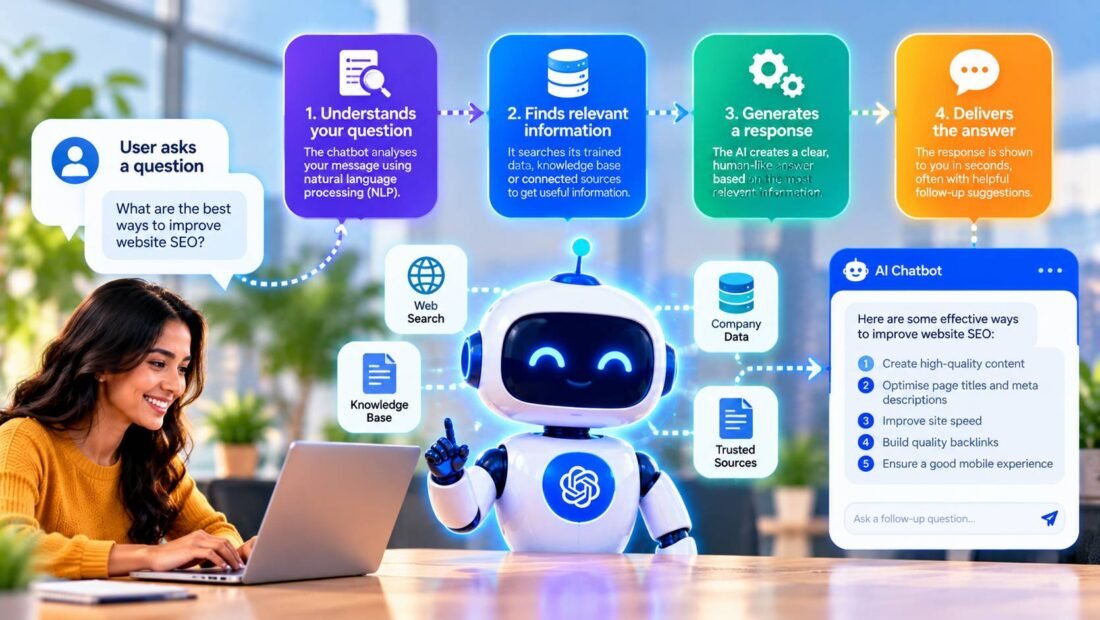
Ask ChatGPT, Claude or Gemini to rewrite an awkward email and you get a polished version in seconds. It is easy to come away thinking the chatbot understood what you meant in the way a colleague would. The reality is stranger, and once you see it, a lot of chatbot behavior starts to make sense.
In short: a modern AI chatbot is a program trained to predict which piece of text should come next. It does this one small piece at a time, extremely fast, using patterns learned from a huge amount of writing.
The engine inside: a large language model
The part doing the work is called a large language model, or LLM. “Large” refers to its size. These models have billions of internal settings, called parameters, that were adjusted during training. Google’s introduction to large language models is a good technical starting point if you want to go deeper.
The chatbot you type into is a layer on top of that model. It manages the conversation, adds instructions the company has written, and sometimes connects the model to extra tools like web search.
Step 1: Training on text
Training starts with a very large collection of text: public web pages, books, articles, code and other sources. The model is shown a passage with the next word hidden and asked to guess it. Every wrong guess adjusts its parameters slightly. Repeat that billions of times and the model gets very good at continuing text in a sensible way.
To predict well, the model has to pick up a lot along the way: grammar, facts that appear often, how arguments are structured, how a polite refusal sounds, how Python code is laid out. Nobody programs these in directly. They emerge from the prediction task.
Step 2: Teaching it to be an assistant
A model trained only on predicting web text would happily continue your question with three more questions, because that is what it often saw online. So there is a second stage.
Companies show the model examples of good assistant answers, and people rate different responses to the same question. The model is then tuned to produce the kind of answer people preferred: helpful, on topic and safe. This is often called reinforcement learning from human feedback.
Step 3: What happens when you type a question
- Your text is split into tokens. A token is a chunk of text, often a word or part of a word. “Unbelievable” might become “un”, “believ” and “able”.
- The model reads the whole conversation. That includes hidden instructions from the company, earlier messages, and your new one. The amount it can read at once is called the context window.
- It predicts the next token. The model calculates how likely each possible next token is, picks one, adds it to the text, and repeats.
- The answer streams out. That is why replies appear word by word rather than all at once.
All of this runs on powerful chips in data centers, which is why chatbots are delivered as cloud services rather than as software you install. Our guide to cloud computing covers how that kind of rented computing works.
Why chatbots sound confident when they are wrong
Because the model is predicting plausible text, it can produce a sentence that reads perfectly and is false. It might invent a statistic, a quote or a court case that never existed. These errors are called hallucinations, and IBM’s explainer on AI hallucinations covers the causes in more detail.
Three things make this more likely:
- the question is about something rare or very recent, so the model saw little reliable text about it;
- the question asks for exact details such as numbers, dates or citations;
- the chatbot is not connected to a search tool or your documents, so it answers from memory alone.
The practical rule: use chatbots to draft, summarize and brainstorm, and check any fact before it goes to a customer.
Do chatbots remember you?
Within one conversation, yes, up to the size of the context window. Between conversations, it depends on the product. Some chatbots have a memory feature that saves notes about you. The underlying model does not learn from your chat in real time, but some providers may use conversations to train future models unless you switch that off. Check the privacy settings of any tool before pasting in customer or financial data.
How small businesses use AI chatbots
- Writing first drafts: emails, product descriptions, job ads, social posts.
- Summarizing: long documents, meeting transcripts, customer feedback.
- Answering customer questions: a chatbot on your website, trained on your FAQs and policies.
- Working with spreadsheets: writing formulas or explaining what a formula does.
- Brainstorming: names, campaign ideas, ways to word a tricky message.
The common thread is that a person reviews the output. Chatbots save the most time on tasks where checking the result is quicker than producing it from scratch.
Rule-based chatbots vs AI chatbots
The website chat widgets from ten years ago worked differently. They followed a script: if the customer clicks “Shipping”, show the shipping answer. They never said anything unexpected, and they could not handle anything outside the script.
AI chatbots generate new answers each time. They handle unusual phrasing well, but they need guardrails, such as limiting them to your own help articles, so they do not make up a refund policy you never had.
Frequently Asked Questions
Does an AI chatbot understand what I say?
Not in the way a person does. It has learned statistical patterns in language well enough to respond usefully, but it does not have beliefs or intentions. Whether that counts as understanding is still debated by researchers.
Where do AI chatbots get their information?
From the text they were trained on, which stops at a cutoff date. Some chatbots can also search the web or read files you upload, which lets them use newer information.
Why does the chatbot give a different answer each time?
There is a small amount of randomness in how it picks each next token. This makes answers sound more natural, and it means the same question can produce slightly different replies.
Are AI chatbots safe to use for business?
They can be, with sensible rules. Use business plans that do not train on your data, avoid pasting sensitive personal information, and have a person check anything that goes to customers.
What is the difference between ChatGPT, Claude and Gemini?
They are made by different companies (OpenAI, Anthropic and Google) and trained differently, so they vary in writing style, strengths and features. All three work on the same basic principle described in this article.






[…] in any language, so a well-written message is no longer evidence it is genuine. Our explainer on how AI chatbots work shows why that text sounds so […]