
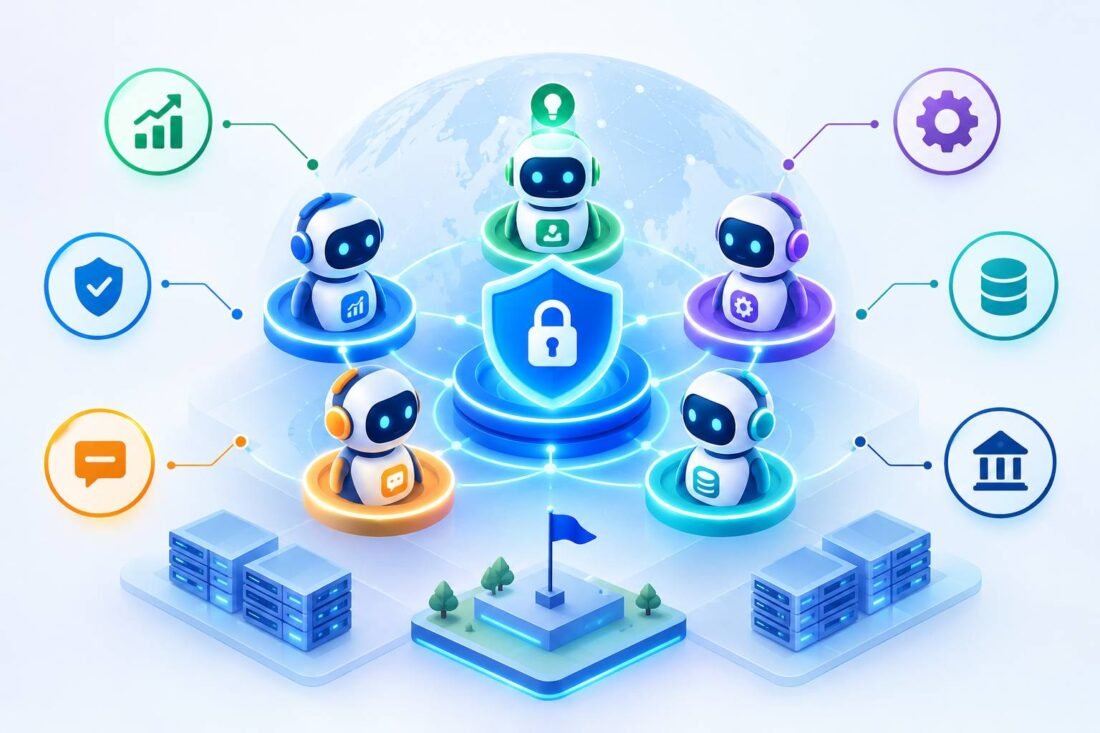
If you run several AI agents that share work, and you need those agents to stay inside your own data, identity, and governance boundaries, adding more agents is rarely the fix when results disappoint.
Most performance problems in these systems come from how agents coordinate, what authority they hold, how they are tested, and where they run.
This guide covers each of those levers, with a look at healthcare, where the constraints are tightest and where real marketplaces such as the Optum AI Marketplace already exist.
What “Sovereign” Means in a Multi-Agent System
There is no single standard definition, so it helps to separate the three ways the word gets used.
The first is infrastructure sovereignty: agents, models, and data run in environments your organization controls, such as your own servers or a private cloud. The OpenHands platform, for example, describes workflows that can run locally, through its cloud service, or inside an enterprise VPC.
The second is identity sovereignty. Research on self-sovereign digital identity for agents, built on decentralized identifiers and verifiable credentials, proposes that each agent carry an identity its operator controls rather than one issued and revoked by a third party.
The third is decision sovereignty. A 2026 ICLR paper describes sovereign agents as ones able to make decisions based on private incentives, shared objectives, and operational constraints, which makes evaluating them a multi-goal problem rather than a single score.
Real deployments usually mix all three. Knowing which one you are working toward tells you what “better performance” should even mean.
Check Whether You Need Multiple Agents at All
Teams often assume that more agents means better results. A Google Research and academic study titled “Towards a Science of Scaling Agent Systems” tested that assumption across 180 configurations, using five architectures and three LLM families. The answer depended heavily on the task.
On work that can be split into parallel pieces, such as financial reasoning where separate agents analyze revenue, costs, and market comparisons, centralized coordination improved performance by about 81% over a single agent.
On sequential work, the picture reversed. In a planning benchmark, every multi-agent variant tested degraded performance, by roughly 39 to 70%, because coordination overhead ate into the reasoning each agent could do within a fixed budget.
The same research reported diminishing or negative returns from adding coordination once a single agent’s baseline accuracy exceeded roughly 45%. If one agent already handles a task well, a second layer of agents may add cost and failure points without adding quality.
A practical first step is to run your task with a single agent and record the result. Add agents only when the work divides cleanly and the single-agent baseline leaves real room to improve.
Match the Coordination Pattern to the Task
When you do need several agents, the structure that connects them matters as much as the models inside them. The same study compared four patterns, and the differences were large.
| Pattern | How it works | What the study found |
|---|---|---|
| Independent | Agents work in parallel with little communication | Errors amplified by up to 17.2x |
| Centralized | An orchestrator assigns work and checks results | Error amplification held to 4.4x |
| Decentralized | Agents communicate peer to peer | Performed better on dynamic web navigation |
| Hybrid | Combines orchestration and peer communication | Generally efficient scaling, with higher coordination cost |
The lesson is not that centralized is always best. It is that unchecked agents pass mistakes to each other, and that a validation step, whether an orchestrator or a dedicated reviewer agent, contains the damage. In sovereign settings, the orchestrator also gives you a natural place to enforce policy, log decisions, and hold the audit trail.
Give Every Agent a Verifiable Identity and Narrow Authority
AI agent identity is often treated as a security topic rather than a performance one, but the two are linked. Agents that cannot tell which peers to trust waste effort re-verifying everything or, worse, accept bad inputs. One research group notes that a core limitation of current LLM-based agents is their inability to build differentiated trust with each other at the start of an agent-to-agent dialogue.
Several proposals address this. A prototype called NostrAgent argues that safe agent deployment needs persistent identity, scoped delegation, peer trust, discovery, and payment, which today live in separate systems.
An IETF individual draft on multi-agent delegation describes a model where authority flows from a human principal through an orchestrator to specialist sub-agents, and is strictly narrowed at every hop. These are research prototypes and an early draft, not adopted standards, so treat them as design guidance rather than something to buy off the shelf.
The practical takeaways hold up regardless of which specification you follow:
- Issue each agent its own credentials instead of sharing one service account.
- Grant only the tools and data a task needs, and shrink permissions as work is delegated downward.
- Make key rotation possible without losing the agent’s history or delegations.
- Log which agent acted, under whose authority, and why.
Narrow scopes also help accuracy. An agent that can only reach the tools relevant to its role has fewer wrong options to choose from.
Measure More Than One Number
A single accuracy score hides trade-offs that matter in sovereign systems, where agents balance speed, cost, privacy limits, and policy compliance. The ICLR paper makes this case directly, arguing that existing evaluations rely predominantly on scalar metrics that do not capture this complex objective landscape.
A workable evaluation set tracks at least these dimensions:
- Task success rate across repeated runs, not a single attempt
- Cost per completed task, including tokens and tool calls
- Latency from request to final output
- Policy violations or blocked actions
- Error propagation, meaning how often one agent’s mistake reaches the final answer
Repeated runs matter. A benchmark of agents in Southeast Asian languages found that English performance does not reliably predict repeated-run robustness in other languages. If your agents serve users in more than one language or region, test in each of them rather than assuming results transfer.
Tune the Runtime, Not Just the Prompts
Prompt wording gets most of the attention, but the execution environment shapes performance too. Open-source coding agents illustrate the options well.
OpenHands, a widely used open-source platform, describes an architecture that combines sandboxed execution, lifecycle control, model-independent routing, and portable local-to-remote execution. For a sovereign deployment, those properties translate into concrete benefits: you can swap models without rewriting agents, keep execution isolated from sensitive systems, and move workloads between environments as requirements change.
An OpenHands AI agent is built for software tasks, so it is one example rather than a template for every use case. The underlying principles carry over: sandbox what agents can touch, make the model layer replaceable, and keep spending and access under central control.
Shared memory deserves the same attention. Agents that start from zero on every task repeat mistakes. Some platforms now treat institutional memory as a governed asset, for instance a product listed on G2 describes performance improvement over time through governed, consensus-validated organizational memory.
Whether you use a product like that or build your own store, decide who may write to shared memory and how entries get validated, because a bad entry will spread to every agent that reads it.
Build, Borrow, or Buy Your Agents
Not every team needs to build agents from scratch. If you are weighing prebuilt agents against custom work, a directory like the AI Agent Marketplace on iNode AI can help you compare what already exists before you commit engineering time. Whatever source you use, apply the same checks: where does the agent run, what data does it see, how is it authenticated, and can you test it in a sandbox first?
What Health AI Agents Add to the Picture
A health AI agent operates under constraints that most other domains do not face. In the US, organizations handling protected health information generally fall under HIPAA, and the HHS HIPAA resource page is the starting point for the Privacy and Security Rules. For governance of AI systems more broadly, NIST publishes a voluntary AI Risk Management Framework. Keeping data inside your own environment helps, but it does not by itself make a system compliant. Access controls, audit logging, vendor agreements, and policies still apply, and requirements vary by organization and use case.
The Optum AI Marketplace as a Real Example
The Optum AI Marketplace is a concrete example of how health-specific AI is being distributed. Based on Optum’s official announcement, here is what is confirmed:
- Optum, a UnitedHealth Group subsidiary, launched it on June 25, 2025, for health care technology companies, providers, and payers.
- It offers a centralized, health care-specific ecosystem of curated solutions and APIs, with products from Optum alongside ServiceNow, Microsoft, and Google.
- Listed application areas include eligibility, claims, engagement, care management, data access, and analytics, and developers get sandbox access to test solutions before full implementation.
- Optum says it plans to add solutions focused on prior authorization, payment integrity, and autonomous clinical documentation.
What is not confirmed in the sources reviewed: pricing, eligibility terms, whether individuals can sign up directly, which listed products are agent-based, and whether any of it supports the sovereign deployment patterns described above.
A job posting on the UnitedHealth Group careers site mentions AI-enabled features, including AI agents in the marketplace team’s work, but that is a hiring description, not a product announcement. Anyone evaluating the marketplace should confirm details directly at marketplace.optum.com or with Optum.
The marketplace is also a different thing from a multi-agent framework. It is a place to find and integrate vendor solutions through APIs. Frameworks like OpenHands, or the coordination research above, address how agents are built and run. A health system might use both.
A Practical Order of Operations
If you are improving an existing system, this sequence tends to produce the clearest gains:
- Baseline the task with a single agent and record success, cost, and latency.
- Add agents only where work can run in parallel, and add a validation step before outputs move on.
- Give each agent its own identity and the smallest permission set that works.
- Build a repeatable test set, run each case several times, and track errors as they spread between agents.
- Review the runtime for sandboxing, model flexibility, and shared-memory controls.
- For healthcare work, involve compliance and security teams before agents touch real patient data.
Where to Start
Pick one workflow that currently uses multiple agents, run it with a single agent for comparison, and track cost and error spread for both versions. That one experiment will tell you more about your system than any benchmark leaderboard, and it shows whether your next investment belongs in coordination, identity controls, or testing.
Published by BlowupCloud.
Frequently Asked Questions
What is a sovereign multi-agent system?
There is no formal standard, but the term generally describes groups of cooperating AI agents that run under an organization’s own control over data, infrastructure, identity, and decision rules.
Do more agents always improve performance?
No. Research on 180 agent configurations found large gains on parallelizable tasks and declines on sequential ones, so the task’s structure should drive the decision.
Why does AI agent identity affect performance?
Verifiable identity lets agents and operators know who is acting and with what authority. That reduces blind trust, limits the damage from a compromised agent, and makes failures easier to trace and fix.
Is OpenHands a multi-agent system?
OpenHands is an open-source platform for AI coding agents. Third-party descriptions say it can handle task decomposition through agent delegation, but it is mainly a software development tool rather than a general sovereign-agent framework.
Is the Optum AI Marketplace open to the public?
Optum describes it as serving health tech companies, providers, and payers. The sources reviewed do not state pricing or individual access terms, so confirm with Optum.
Does running agents on my own infrastructure make them HIPAA compliant?
Not automatically. HIPAA compliance depends on safeguards, policies, and agreements around the system, not only where it runs.