
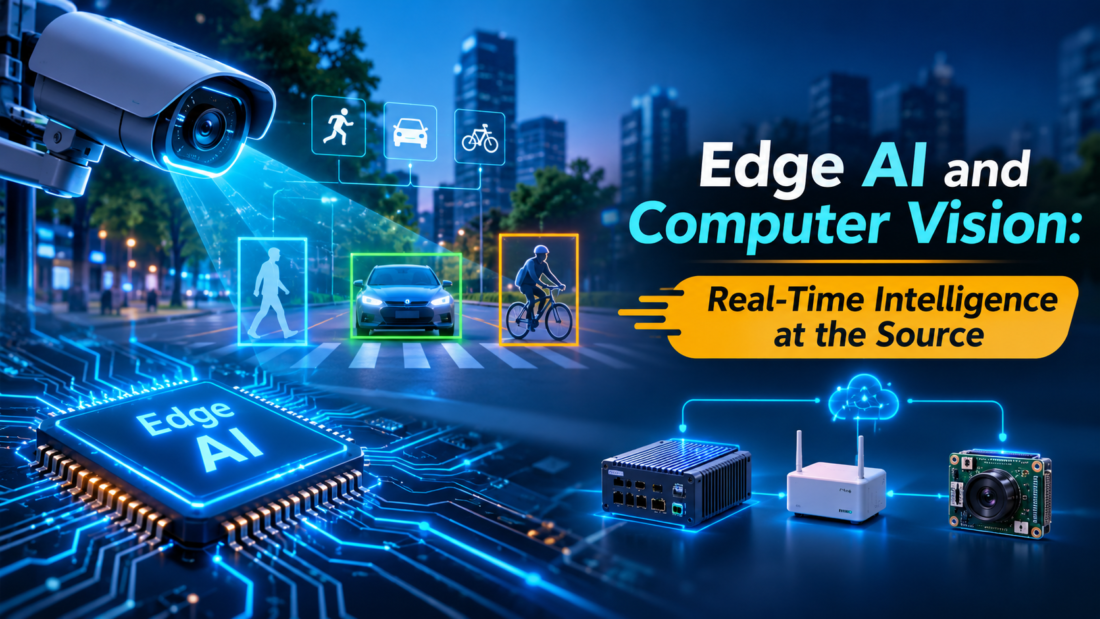
Sending every camera frame to the cloud for analysis sounds simple until you count the costs. A single high-resolution camera can generate huge volumes of data every day. Multiply that across a factory, a retail estate or a fleet of vehicles and bandwidth bills climb, latency grows and anything that depends on a network connection stops working when the connection drops. Edge AI computer vision solves this by running AI models on or near the camera itself, making decisions in milliseconds, right where the images are captured.
Edge AI means processing data locally, on devices such as smart cameras, embedded computers, gateways or on-premises servers, rather than in a distant data centre. For computer vision, that enables real-time responses (stopping a machine, spraying a weed, alerting a guard), reduces the amount of data transmitted and keeps sensitive images on site.
Hardware advances have made this practical. Compact AI accelerators now run sophisticated vision models at low power and modest cost, and model optimisation techniques squeeze large networks onto small devices.
This guide is for CTOs, IT and OT managers, operations directors, product leaders and founders in UK and US organisations. It explains how edge AI differs from cloud AI, the main hardware options, where on-device computer vision creates most value, how John Deere uses edge vision to cut herbicide use, how to deploy and manage models across many devices and the trade-offs to plan for.
Edge AI vs Cloud AI
| Factor | Edge AI | Cloud AI |
|---|---|---|
| Latency | Milliseconds, no network round trip | Depends on connectivity, often hundreds of milliseconds or more |
| Bandwidth | Sends only results or selected images | Streams large volumes of video or images |
| Offline operation | Continues working without a connection | Stops or degrades when disconnected |
| Privacy | Raw images can stay on site or on device | Images leave the premises |
| Compute power | Limited by device size, power and heat | Virtually unlimited |
| Model updates | Must be distributed to many devices | Updated centrally |
| Cost profile | Upfront hardware, lower ongoing data costs | Lower upfront, ongoing compute and transfer costs |
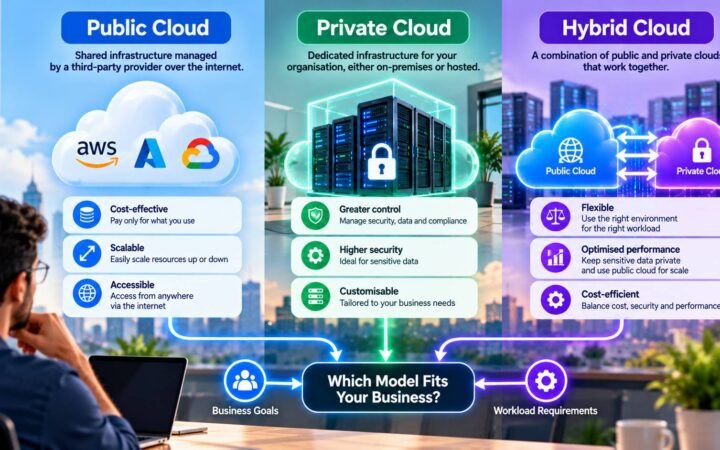
Most real deployments are hybrid. Edge devices handle real-time inference, while the cloud handles model training, fleet management, analytics across sites and storage of selected data. This distributed AI processing model gives the best of both.
When Does Edge AI Make Sense?
- Decisions must be immediate, such as rejecting a defective product, triggering a safety stop or guiding a robot.
- Connectivity is unreliable, as in vehicles, farms, remote infrastructure, ships or underground sites.
- Video volumes are large, making continuous upload expensive or impractical.
- Privacy matters, and only anonymised results should leave the device.
- Resilience is essential, so operations must continue during network outages.
Cloud-only processing remains sensible for tasks without tight latency requirements, such as overnight analysis of recorded footage, document processing or training models.
Edge Vision Hardware Options
| Hardware type | Typical use | Considerations |
|---|---|---|
| Smart cameras with built-in AI | Security analytics, simple inspection | Convenient but limited flexibility and processing |
| Embedded AI modules (for example NVIDIA Jetson class devices) | Robotics, vehicles, inspection, drones | Strong performance per watt, needs engineering integration |
| AI accelerators (NPUs, TPUs, VPUs) | Adding AI to gateways, PCs and IoT devices | Efficient for specific model types |
| Industrial edge PCs with GPUs | Multiple camera streams, complex models | Higher power and cost, more capability |
| On-premises edge servers | Site-wide video analytics | Centralised on site, needs data centre-style management |
Choice depends on the number of cameras, model complexity, frame rate, power availability, environmental conditions and budget. Ruggedised hardware is essential for factories, vehicles and outdoor sites.
Making Models Fit the Edge
Large models trained on powerful GPUs usually need optimising before they run efficiently on edge devices. Common techniques include:
- Quantisation: reducing numerical precision, for example from 32-bit to 8-bit, to cut memory and speed up inference
- Pruning: removing parts of the network that contribute little to accuracy
- Knowledge distillation: training a small model to mimic a larger one
- Efficient architectures: choosing models designed for mobile and embedded use
- Hardware-specific compilation: converting models with vendor toolkits to exploit the device’s accelerator
Each step trades a little accuracy for speed and efficiency, so validate carefully on real data after optimisation.
Edge AI Applications Across Industries
Edge AI in Manufacturing
Inline quality inspection, robot guidance, worker safety zones and predictive maintenance using vision and sensor data all benefit from millisecond decisions on the factory floor.
Edge AI for Security Cameras
Analysing video on or near cameras detects intrusions and incidents in real time while sending only alerts and short clips, reducing bandwidth and limiting how much footage leaves the site.
Retail
Shelf monitoring, queue detection and self-checkout assistance can run in-store, keeping customer images local.
Transport and Logistics
In-vehicle driver monitoring, collision warnings, number plate recognition and parcel sorting rely on edge processing, especially where connectivity varies.
Agriculture
Vision-guided machinery identifies crops, weeds and livestock in the field, where connectivity is limited and decisions must be instant.
Smart Cities and Infrastructure
Traffic monitoring, rail and road inspection and utility asset monitoring use edge devices to process data close to the source.
Real Business Example: John Deere See & Spray
The challenge
Farmers traditionally apply herbicide across entire fields, even though weeds may cover only a fraction of the area. That wastes chemicals, adds cost and increases environmental impact. Cloud processing is not an option for a sprayer moving across a field at speed with limited connectivity.
The solution
John Deere introduced See & Spray in 2021. Cameras mounted along the sprayer boom capture images of the crop, and onboard processors decide in real time whether each plant is a crop or a weed. When a weed is detected, the system triggers the individual nozzle above it to spray only that spot.
Implementation
The cameras scan more than 2,100 square feet of crop per second at speeds up to 15mph. All the vision processing happens on the machine, a clear example of edge AI where the decision to spray must be made in a fraction of a second. Deere offers the technology on a per-acre basis, so farmers pay for the area where it is used.
Business outcome
John Deere reported that in 2024 See & Spray was used on more than one million acres, saving an estimated 8 million gallons of herbicide mix, an average herbicide saving of 59% across corn, soybean and cotton fields in the US. Independent trials by Iowa State University also recorded substantial savings.
The lessons extend well beyond farming: when decisions must be instant and connectivity cannot be relied upon, putting vision intelligence on the device creates value that cloud processing cannot.
Edge AI Deployment and Fleet Management
Deploying one edge device is straightforward. Managing hundreds or thousands is not. A sound edge AI deployment approach covers:
- Remote provisioning of devices, certificates and configuration
- Over-the-air model updates with staged rollouts and the ability to roll back
- Monitoring of device health, inference speed, accuracy indicators and data drift
- Selective data upload of uncertain or unusual images to improve future models
- Security including secure boot, encrypted storage, patching and network segmentation
- Lifecycle management for hardware replacement and end-of-life
IIH Global’s AI infrastructure and MLOps services put these capabilities in place so edge fleets stay accurate, secure and manageable.
Trade-offs and Challenges
- Limited compute. Edge devices cannot run the largest models, so accuracy and speed must be balanced.
- Hardware cost and diversity. Different devices across sites complicate deployment and support.
- Physical security. Devices in accessible locations can be tampered with or stolen.
- Environmental stress. Heat, dust, vibration and moisture shorten hardware life.
- Update complexity. Pushing new models to many devices safely requires mature tooling.
- Skills. Edge AI combines machine learning, embedded engineering and operations, a rare mix of expertise.
Estimating Edge AI Costs
| Cost element | What to consider |
|---|---|
| Edge hardware | Price per device multiplied by sites and cameras, plus spares |
| Installation | Mounting, power, networking and ruggedised enclosures |
| Model development and optimisation | Training, compression and testing on target hardware |
| Fleet management platform | Device provisioning, updates and monitoring tools |
| Connectivity | Reduced compared with cloud streaming, but still needed for updates and results |
| Maintenance and replacement | Hardware failures, cleaning and planned refresh cycles |
Compare these with the cost of a cloud-only approach, including continuous video transfer and cloud compute. For high-volume video or many locations, edge processing often becomes cheaper within a year or two, while also delivering faster decisions.
Getting Started
- Identify use cases where latency, bandwidth, connectivity or privacy make edge processing necessary.
- Define accuracy, speed and power requirements.
- Prototype models and benchmark them on candidate hardware with real data.
- Design the hybrid architecture: what runs at the edge, what runs in the cloud.
- Pilot at one site, including remote updates and monitoring.
- Scale with standardised hardware and fleet management.
Our computer vision development services cover model design, edge optimisation and hardware integration for real-time applications.
The Future of Edge AI
AI accelerators are becoming standard in cameras, phones, vehicles and industrial PCs. Small vision-language models are starting to run at the edge, enabling devices to describe scenes and answer questions locally. Federated learning allows models to improve from data across many devices without centralising raw images, strengthening privacy. As 5G private networks and IoT edge AI mature, expect more distributed intelligence, with devices collaborating locally and the cloud coordinating learning and oversight.
Conclusion
Edge AI computer vision enables businesses to make real-time decisions directly on devices, reducing latency, bandwidth consumption and privacy risks while maintaining reliable operations even without network connectivity. John Deere’s See & Spray demonstrates how on-device intelligence can deliver practical benefits at scale.
To achieve similar results, businesses must select the right use cases, optimise AI models for suitable hardware and manage device fleets securely. Businesses looking to implement these capabilities can hire AI developers with expertise in computer vision, edge computing and machine learning to build efficient, scalable and reliable AI solutions that deliver measurable operational value.
Need instant decisions where your cameras are? Talk to IIH Global about edge AI vision solutions.
Published by Blowup Cloud
Frequently Asked Questions
What is edge AI computer vision?
It runs computer vision models on or near cameras and devices rather than in the cloud, enabling real-time decisions, lower bandwidth use and better privacy.
What is the difference between edge AI and cloud AI?
Edge AI processes data locally for speed, resilience and privacy. Cloud AI offers greater compute power and central management. Most systems combine both approaches.
What hardware is used for edge AI?
Common options include smart cameras, embedded AI modules, AI accelerators, industrial edge PCs with GPUs and on-premises edge servers, chosen by workload and environment.
Can edge AI work without internet connectivity?
Yes. Models run locally, so inference continues offline. Devices typically synchronise results and receive updates when connectivity returns.
How are AI models updated on edge devices?
Through over-the-air updates managed by an MLOps or device management platform, using staged rollouts, monitoring and rollback to protect operations.