
For most of its history, business AI worked quietly in the background. It sorted spam, flagged suspicious card payments and recommended products. It labeled and predicted things, but it did not make anything new.
Generative AI is different. It produces new content (text, images, audio, video or code) from a short instruction called a prompt. Type “write a polite reminder for an overdue invoice” and you get a draft. Type “a flat-lay photo of handmade soap on slate” and you get an image that never existed before.
How generative AI works, briefly
Generative models are trained on very large collections of examples. A text model learns from written language, an image model from pictures paired with descriptions. During training, the model learns the patterns in that material well enough to produce new examples that follow the same patterns.
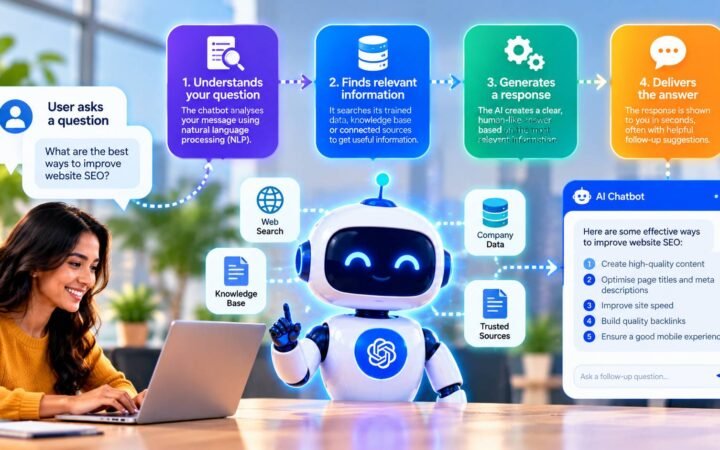
Text tools such as ChatGPT, Claude and Gemini are built on large language models that predict text one piece at a time. Our explainer on how AI chatbots work walks through that process step by step. Image tools mostly use a different method called diffusion, which starts from random noise and gradually shapes it into a picture that matches the prompt.
IBM’s overview of generative AI covers the main model types in more technical detail.
Types of generative AI tools
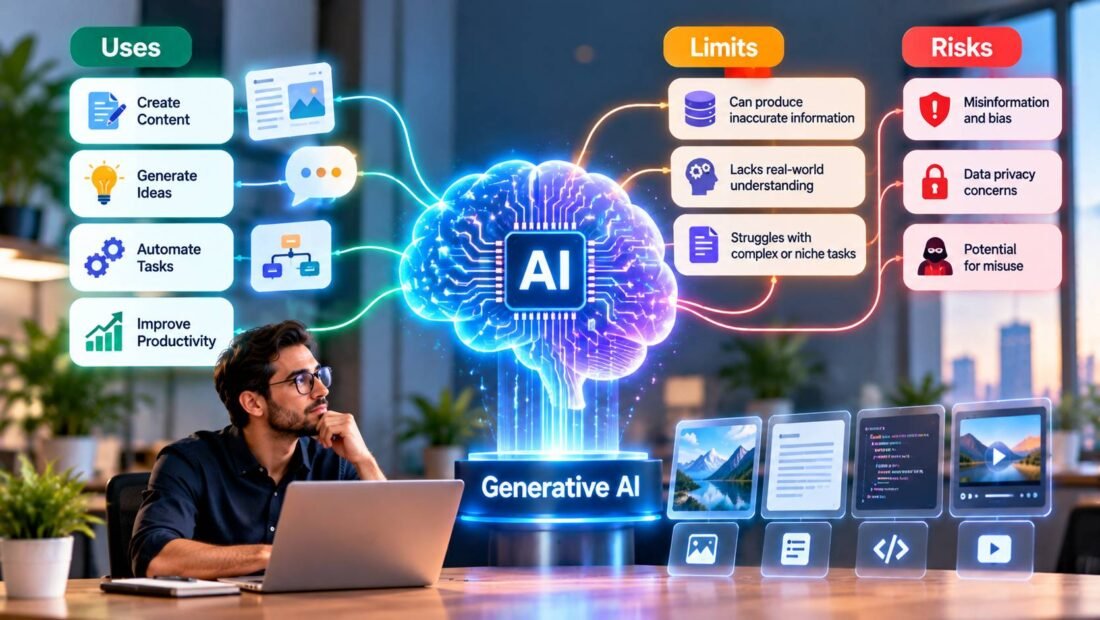
- Text: drafting, rewriting, summarizing and translating. ChatGPT, Claude, Gemini and Microsoft Copilot.
- Images: illustrations, product mockups and social graphics. Midjourney, Adobe Firefly, DALL-E and Canva’s AI tools.
- Audio: voiceovers, music and transcription. ElevenLabs is one widely used example.
- Video: short clips and talking-head videos generated from scripts.
- Code: writing, explaining and fixing code. GitHub Copilot and AI coding assistants.
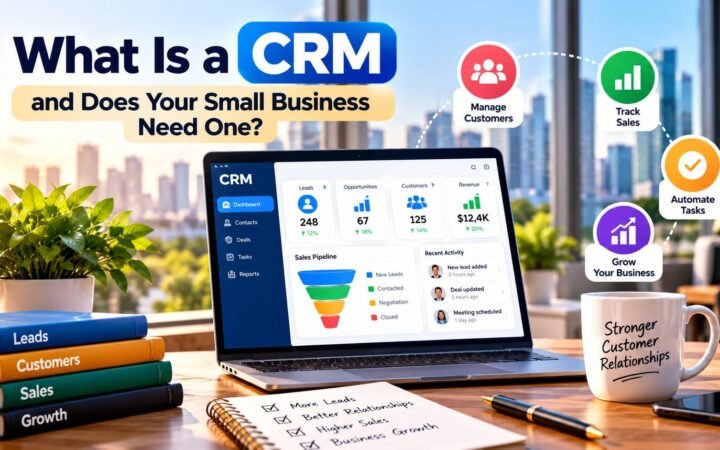
Many business tools now include generative features inside them, so you may use generative AI in your email, CRM or design software without opening a separate app.
Where generative AI helps a small business
First drafts
Product descriptions, job adverts, blog outlines, proposal sections and email replies. The time saving comes from not starting with a blank page. A person still edits.
Summaries
Turning a 40-page contract, a long email thread or an hour of meeting notes into the key points. This is one of the most reliable uses, as long as someone checks the summary against the source for anything important.
Customer support
Drafting replies to common questions, or powering a website assistant that answers from your own help articles.
Marketing visuals
Background images, concept art for campaigns and quick social graphics. Real product photos still matter for anything customers will buy based on appearance.
Working with data
Writing spreadsheet formulas, explaining what a formula does, or describing the trend in a chart in plain words.
Where it falls short
It can be confidently wrong
Text models sometimes invent facts, figures, quotes and sources. These are called hallucinations. Anything factual that leaves your business, such as a price, a legal statement or a statistic, needs to be checked by a person.
Generic output
Without context, AI produces the average of what it has seen. The writing is smooth and forgettable. Giving it your own examples, details and tone instructions makes the output far more useful.
Limited knowledge of your business
A general model does not know your prices, policies or customers unless you tell it, or unless the tool is connected to your documents.
Out-of-date information
Models learn from data up to a training cutoff. Unless the tool searches the web, it may not know about recent changes.
The risks to manage
- Data privacy. Pasting customer details or confidential documents into a consumer AI tool may mean that data is stored or used for training. Use business plans with clear data terms, and keep sensitive personal information out.
- Copyright and ownership. The law on AI-generated content is still developing and varies by country. Avoid prompts that copy a specific artist or brand, and keep human creative input in anything you want to own.
- Accuracy and liability. If an AI-written answer gives a customer wrong information, your business is still responsible for it.
- Misuse by attackers. Scammers use the same tools to write convincing fake emails and clone voices. Our guide to spotting phishing emails covers how to respond.
- Over-reliance. If nobody on the team can do the task without AI, quality drops the day the tool changes or goes down.
For a structured way to think about these risks, the NIST AI Risk Management Framework is a free, widely referenced guide. It is written for organizations of all sizes, and its core ideas apply to a small team.
A sensible way to start
- Pick one repetitive writing or summarizing task that takes real time each week.
- Try two or three tools on that task using real (non-sensitive) examples.
- Write down a few simple rules: what data must never be pasted in, and what must always be checked by a person.
- Measure the time saved after a month. Expand to the next task only if the first one worked.
Published by BlowupCloud.
Frequently Asked Questions
What is the difference between AI and generative AI?
AI is the broad field of computer systems that perform tasks needing something like human judgment. Generative AI is the part of that field focused on creating new content, rather than classifying or predicting.
Is ChatGPT generative AI?
Yes. It is a generative AI tool built on a large language model.
Can I use AI-generated images commercially?
Many tools allow commercial use under their terms, but the rules differ by tool and by country. Read the tool's license, and avoid images that imitate a real brand, person or artist.
Will generative AI replace my staff?
For most small businesses, it changes tasks more than it replaces roles. It speeds up drafting and summarizing, while people still handle judgment, relationships and final checks.
How much does generative AI cost?
Many tools have free plans. Business plans with stronger privacy terms typically charge per user per month, and AI features are increasingly included in software you already pay for.